
- Companies that get hacked face stricter laws than firms unleashing rogue AI. We can fix that
 by Rob Nicholls, Senior Research Associate in Media and Communications, University of Sydney on October 15, 2026 at 6:57 pm
Just as car makers have to report and pay to fix faulty airbags, AI companies should be legally responsible for their faulty products.
- The trouble with Flock cameras is the surveillance system’s architecture, not just some of its users
 by Henry F. Fradella, Professor of Criminology and Criminal Justice, Arizona State University on October 1, 2026 at 12:41 pm
The architecture of automated license plate readers turns local cameras into a far-reaching surveillance network that can be accessed by agencies that never purchased the devices.
- What does the OpenAI Medicare hack reveal about Australia’s cyber security?
 by Meena Jha, Associate Professor, College of Information & Communication Technology, School of Engineering and Technology, CQUniversity Australia on September 24, 2026 at 4:00 am
We need to ask how ready Australian government systems are for increasingly capable AI agents.
- Calls for global regulation of AI are growing. What exactly could it look like?
 by Stan Karanasios, Professor in Information Systems, The University of Queensland on September 21, 2026 at 8:09 pm
AI is a global technology. A global approach to regulating it is urgently needed.
- The Origin Energy breach has been unusual – but there are ways to better protect your data
 by Mohiuddin Ahmed, Associate Professor in Cyber Security, Adelaide University on July 24, 2026 at 2:40 am
With rapid advances in AI, scammers have access to more sophisticated tools, including fake documents and more personalised targeting.
- Trump’s AI security order acknowledges risks but stops short of regulating industry
 by Anjana Susarla, Professor of Information Systems, Michigan State University on June 12, 2026 at 12:21 pm
The executive order is voluntary for AI companies but aligns with AI safety experts on the potential for harm.
- Australia now has access to Anthropic’s Claude Mythos. It may improve cyber safety – but not for everyone
 by Andrew Cullen, Senior Research Fellow, School of Computing and Information Systems, The University of Melbourne on June 4, 2026 at 11:35 pm
The AI era has fundamentally changed the risks associated with poor cybersecurity practices.
- Police equipment can be tracked via Bluetooth. What about your phone, watch and headphones?
 by Paul Haskell-Dowland, Professor of Cyber Security Practice, Edith Cowan University on May 4, 2026 at 5:31 am
Unless you go completely offline, you cannot completely eliminate the risk of being tracked.
- Why the world’s banks are so worried about Anthropic’s latest AI model
 by Toby Walsh, Professor of AI, Research Group Leader, UNSW on April 23, 2026 at 8:09 pm
Anthropic’s latest model – Mythos – has spooked the world of finance. So it’s a good idea to keep your computer and banking apps updated.
- How Iranian hackers pose a threat to US critical infrastructure
 by William Akoto, Assistant Professor of Global Security, American University School of International Service on April 2, 2026 at 12:46 pm
A cyberattack on a US corporation illustrates how state-aligned hackers operate, and how damage in war today isn’t always readily visible or geographically confined.
- How ‘digital twins’ could help prevent cyber-attacks on the food industry
 by Sabah Suhail, Research Fellow, School of Electronics, Electrical Engineering and Computer Science, Queen’s University Belfast on November 27, 2025 at 1:32 pm
Digital twins allow organisations to simulate real-time events.
- An AI lab says Chinese-backed bots are running cyber espionage attacks. Experts have questions
 by Toby Murray, Professor of Cybersecurity, School of Computing and Information Systems, The University of Melbourne on November 17, 2025 at 3:57 am
Anthropic says its Claude Code tool was used in a sophisticated, automated campaign to steal sensitive information.
- The threat of sabotage from China is growing. That’s not an excuse to erode Australians’ freedoms
 by Ihsan Yilmaz, Deputy Directory (Research Development), Deakin Institute for Citizenship and Globalisation & Research Professor of Political Science and International Relations, Deakin University on November 14, 2025 at 12:44 am
There’s a risk of a slide towards digital authoritarianism as Australia responds to these growing threats.
- ‘High-impact sabotage’: spy chief issues grave warning about espionage and sabotage threat
 by Sarah Kendall, Adjunct Research Fellow, The University of Queensland; Griffith University on November 13, 2025 at 12:33 am
The head of ASIO says authoritarian regimes are more willing to disrupt critical infrastructure to damage the economy and sow social discord.
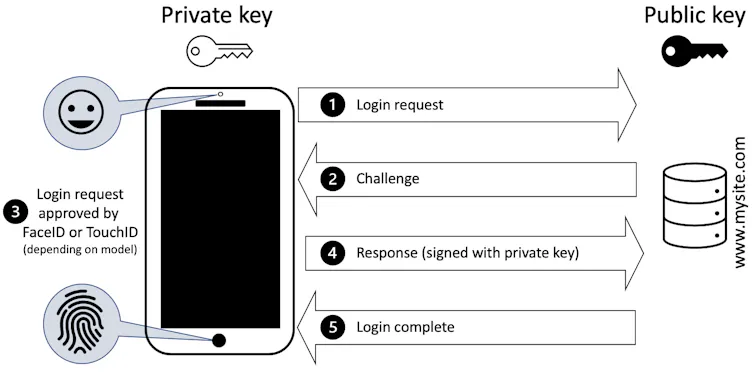
- What’s the difference between passwords and passkeys? It’s not just the protection they provide
 by Paul Haskell-Dowland, Professor of Cyber Security Practice, Edith Cowan University on October 23, 2025 at 11:31 pm
Passkeys are stronger than passwords by design. But they have other benefits too.
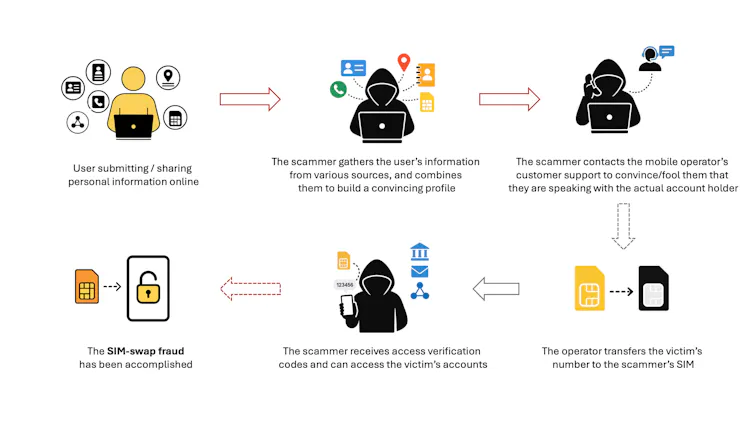
- M&S cyberattacks used a little-known but dangerous technique – and anyone could be vulnerable
 by Hossein Abroshan, Senior Lecturer, School of Computing and Information Science, Anglia Ruskin University on May 14, 2025 at 3:09 pm
Sim-swap fraud is becoming increasingly prevalent.
- Major cybercrime crackdowns signal shift in global cybersecurity strategies
 by Christine Abdalla Mikhaeil, Assistant professor in information systems, IÉSEG School of Management on November 24, 2024 at 2:32 pm
International law enforcement efforts against ransomware groups achieved successes in 2024. More global coordination is needed to keep up with cybercriminals, who are constantly adapting.
- The dangers of voice cloning and how to combat it
 by Leo S.F. Lin, Senior Lecturer in Policing Studies, Charles Sturt University on October 9, 2024 at 6:58 pm
In just seconds, scammers can clone a voice and use it to extort people. What can be done to safeguard against the threat?
- As an ethical hacker, I can’t believe the risks people routinely take when they access the internet in public
 by Christopher Patrick Hawkins, Lecturer in Cyber Security and Computer Science, University of Staffordshire on October 8, 2024 at 4:25 pm
If you’re tempted to do a make a couple of cheeky payments while waiting for the band to come on, think again.
- Is your car a threat to national security? It can be – regardless of where it’s made
 by Dennis B. Desmond, Lecturer, Cyberintelligence and Cybercrime Investigations, University of the Sunshine Coast on October 2, 2024 at 3:03 am
Modern cars made in most countries have remote control and online data features. What matters is who can access that data – and the vehicle itself.
- How to avoid being hacked: start by upping your password game – ‘12345’ doesn’t cut it
 by Thembekile Olivia Mayayise, Senior Lecturer, University of the Witwatersrand on June 16, 2024 at 10:41 am
The question has shifted from whether cyberattacks will occur to when and how they will happen.
- China turns to private hackers as it cracks down on online activists on Tiananmen Square anniversary
 by Christopher K. Tong, Associate Professor of Asian Studies, University of Maryland, Baltimore County on May 31, 2024 at 1:02 pm
Beijing’s cyber operations are largely conducted in the shadows. But a recent leak has shed light on how the state is working with private companies to target online activism.
- MediSecure data breach: why is health data so lucrative for hackers?
 by Megan Prictor, Senior Lecturer in Law, The University of Melbourne on May 20, 2024 at 5:23 am
We don’t know much about the nature of this large-scale ransomware attack. But it’s not entirely surprising – health data is a prime target for cybercrime.
- What is credential stuffing and how can I protect myself? A cybersecurity researcher explains
 by David Tuffley, Senior Lecturer in Applied Ethics & CyberSecurity, Griffith University on January 18, 2024 at 3:32 am
In what is colourfully termed a ‘brute force’ attack, hackers use bots to test millions of username and password combinations on different websites – until they find a match.
- What is LockBit, the cybercrime gang hacking some of the world’s largest organisations?
 by Jennifer Medbury, Lecturer in Intelligence and Security, Edith Cowan University on November 16, 2023 at 11:59 pm
Prolific and highly profitable, LockBit provides ransomware as a service. Aspiring cybercriminals sign up to the scheme, and the group takes a cut. Here’s how it works.

Hacking The Conversation




We are an ethical website cyber security team and we perform security assessments to protect our clients.