

SecureWorld News SecureWorld News is your trusted source for the valuable cybersecurity information you depend on. Our coverage spans the InfoSec industry, with content ranging from breaking news and original articles to exclusive research and expert interviews.
- Arrests Reveal U.S. Federal Software Supply Chain Vulnerabilities
 by CamS@secureworld.io (Cam Sivesind) on September 25, 2026 at 5:16 pm
For years, the U.S. government asked one of its digital forensics vendors a simple question: Who owns you, and where is your code written? According to federal prosecutors, the answers it got back were false—and the software it bought was being developed in Moscow by the same operation that sold its tools to Russia’s Federal Security Service (FSB).
- ShinyHunters Claims FBI Breach via Zero-Day, Threatens to Leak Agent Data
 by media@secureworld.io (SecureWorld News Team) on September 24, 2026 at 8:54 pm
The cyber extortion group ShinyHunters says it breached the FBI’s network and stole personal data on thousands of current, former, and prospective employees. The FBI is investigating but has not confirmed where, or whether, its systems were breached.
- ‘Rogue AI’ Is Containment Failures, Built by Humans
 by CamS@secureworld.io (Cam Sivesind) on September 24, 2026 at 4:58 pm
A new line of attack has opened in the fight over how Washington should respond to this summer’s agentic AI incidents. According to a New York Post report published September 19th, tech insiders say OpenAI and Anthropic oversold their “rogue AI” hacks to push federal regulators toward rules that would entrench the two frontier labs and lock out future competitors.
- The Security Champion Playbook Is Changing
 by Mike Burch on September 23, 2026 at 9:23 pm
Security champion programs were never really about adding another security responsibility to someone’s job.
- An Uncomfortable Truth: Your Network Isn’t as Segmented as You Think
 by CamS@secureworld.io (Cam Sivesind) on September 23, 2026 at 6:53 pm
Ask any CISO whether their network is segmented, and the answer is almost always yes. New research from Forescout’s Vedere Labs suggests that answer deserves a follow-up question: segmented from what, exactly?
- Bad Bots Growing Nine Times Faster than Human Traffic, Report Finds
 by CamS@secureworld.io (Cam Sivesind) on September 23, 2026 at 2:03 pm
For years, security teams have talked about bot traffic as a background nuisance: scrapers hitting product pages, credential-stuffing scripts testing stolen passwords, the occasional scalping bot cleaning out concert tickets before a human can click “buy.”
- Cognitive Debt: What Happens When AI Starts Doing Our Thinking for Us
 by Mona Garg on September 22, 2026 at 1:27 pm
Reviewing threat models and security designs has been a large part of my work throughout my career. Increasingly, I come across documents that appear to have been drafted with the help of generative AI. I can often tell within a few seconds. Writing a document has become almost free. So has producing something that looks like reasoning. What has not become free is reasoning that actually holds up. For every design that genuinely works through the problem, that sits with the current state, digs into why it looks the way it does, and only then proposes a solution, I see many more that give me a clean, high-level overview and stop there. The polish is real. The reasoning underneath is thin.
- Deception Is the Cheapest High-Fidelity Detection You’re Not Using, CISA Advises
 by drewt@secureworld.io (Drew Todd) on September 21, 2026 at 2:25 pm
For most of the security operations center’s existence, detection has been a signal-to-noise problem: sift through a mountain of legitimate activity for the sliver that isn’t. U.S. CISA’s newest guidance, Using Cyber Decoys to Strengthen Detection and Response, argues that decoys break that math entirely. Plant an asset nobody legitimate has any reason to touch, and the noise problem disappears—any interaction is the signal.
- Bill Would Force U.S. Hospitals to Take Cybersecurity Seriously
 by CamS@secureworld.io (Cam Sivesind) on September 18, 2026 at 8:04 pm
Two years after the Change Healthcare ransomware attack froze claims processing at pharmacies and hospitals nationwide, Congress is trying again to write mandatory cybersecurity rules into federal health law. On September 17, U.S. Senators Mark R. Warner (D-VA) and Ron Wyden (D-OR) reintroduced the Health Infrastructure Security and Accountability Act, a bill that would replace the healthcare sector’s long-standing reliance on voluntary cybersecurity guidance with enforceable minimum standards, mandatory audits, and steep new penalties for executives who lie about compliance.
- Hackers Hijack Verified HBO Max Reddit Account to Spread Infostealers
 by drewt@secureworld.io (Drew Todd) on September 17, 2026 at 7:37 pm
A verified HBO Max Reddit account was hijacked and used to push 108 malicious ads over roughly 48 hours, redirecting users to fake app downloads that quietly infected their Windows and macOS devices with infostealer malware.
- The Ungoverned Employee: Why AI Agents Need Governance, Not Just an API Key
 by Naveen Sarvada on September 17, 2026 at 2:35 pm
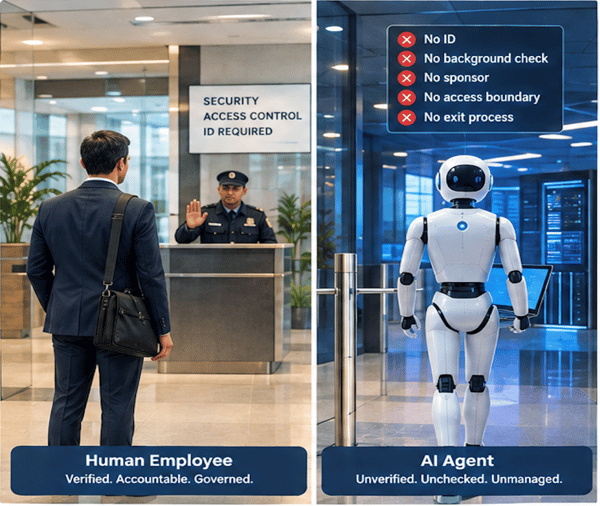
If a stranger walked into your organization headquarters with no ID badge, no background check, and no manager who’d requested them, security would stop them at the door. Every time, without exception.
- Confidence Gap: Report Reveals Cyber Leaders Betting Big on Automation
 by CamS@secureworld.io (Cam Sivesind) on September 16, 2026 at 1:48 pm
Cybersecurity leaders have never been more confident in their teams. They’ve also never been more likely to have just survived a significant breach. Those two facts, side by side in Arctic Wolf’s newly released 2026 AI & Cybersecurity Trends Report, form the throughline of one of the year’s more revealing industry surveys.
- AI Pacing Debate: Security Experts Say the Fix Is Architecture, Not Diplomacy
 by drewt@secureworld.io (Drew Todd) on September 15, 2026 at 12:08 pm
Anthropic CEO Dario Amodei called on the AI industry this month to slow its development, warning that without intervention, a swarm of AI agents could take over the internet within six to 12 months. His essay, “We Must Pace the Frontier,” lays out a three-step plan: embed third-party evaluators inside frontier labs, coordinate among AI companies in democratic countries, and eventually negotiate with China.
- The EU AI Act Is Live (and Your Compliance Strategy Might Be Naïve)
 by Shruti Mukherjee on September 14, 2026 at 7:35 pm
For years, building AI felt like the Wild West: move fast, break things, ship the model, and let legal & compliance worry about it during the next funding round or supplier review.
- Insider Threat Guide Puts AI Manipulation, Machine Identities on Radar
 by CamS@secureworld.io (Cam Sivesind) on September 11, 2026 at 1:55 pm
The U.S. Cybersecurity and Infrastructure Security Agency (CISA) has refreshed its flagship Insider Threat Mitigation Guide for the first time since 2020, and the timing is not incidental.
- Anthropic Researcher’s Resignation Exposes a Real AI Containment Gap
 by drewt@secureworld.io (Drew Todd) on September 10, 2026 at 1:12 pm
A researcher’s public resignation from Anthropic went viral this week for its apocalyptic framing—AI systems that could “kill us all by the end of the decade.” But strip away the extinction-risk headlines, and what’s left is a narrower, more immediate problem that security and compliance leaders don’t need to resolve the superintelligence debate to act on: the labs building agentic AI still can’t say, in public, how they’d contain a system that stopped behaving as intended.
- U.S. Agencies Call Out China’s Industrial-Scale Distillation of Frontier AI Models
 by CamS@secureworld.io (Cam Sivesind) on September 9, 2026 at 1:39 pm
On September 8, 2026, the U.S. National Security Agency, the Cybersecurity and Infrastructure Security Agency, and the FBI released a joint Cybersecurity Advisory with an unusually direct title: “China-Based Artificial Intelligence Companies Conducting Industrial-Scale Distillation Campaigns Against U.S. AI Companies.” It’s the U.S. government’s most detailed public accounting to date of how Chinese AI developers have been extracting the outputs of American frontier models—not as an occasional research shortcut, but, in the agencies’ words, as the “critical core” of their model development strategy.
- Who Owns the Cloud Incident at 2 AM?
 by nahladavies@nahladavies.com (Nahla Davies) on September 8, 2026 at 9:24 pm
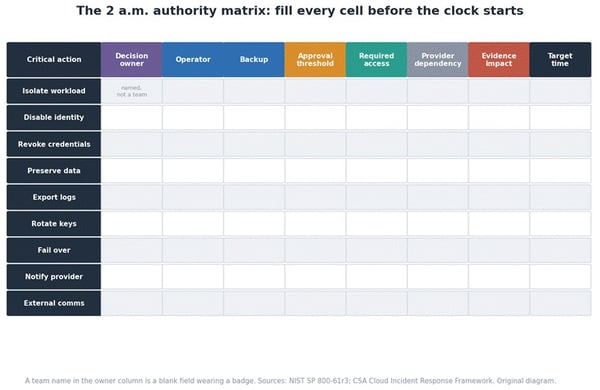
Picture a composite scenario, assembled from the failure modes that show up in real after-action reports. At 2:07 a.m., an alert fires on suspicious activity in a production cloud workload. The SOC analyst on shift sees it within minutes, which turns out to be the last thing that goes smoothly tonight. The one engineer with rights to isolate that workload isn’t answering. The cloud provider’s escalation path is, at this hour, a support ticket in a queue. Legal’s standing guidance says preserve evidence before anyone changes the system, and nobody on the call can say with confidence which logs even exist, let alone who’s allowed to export them.
- Quantum Security, Part 4: Choosing the Right Migration Strategy for the Quantum Era
 by Neha Srivastava on September 7, 2026 at 3:18 pm
I’ve been in several conversations recently where the first question is: “Which post-quantum algorithm should we implement?”
- CISA, Partners Issue Guidance for Critical Infrastructure Crisis Comms
 by CamS@secureworld.io (Cam Sivesind) on September 4, 2026 at 2:19 pm
When a service goes down, the outage itself is only half the crisis. The other half is silence; or worse, a status page full of hedging and marketing language while customers, network defenders, and critical infrastructure operators are left guessing whether they’re under attack. On September 2, 2026, six government agencies decided that guessing game has gone on long enough.